Wednesday, May 21, 2014

One Point Perspectives and Mashup

One Point Perspectives


Mashup - Yakov Chernikhov and Constructivism

Constructivist architecture is a form of modern architecture, popular in the Soviet Union between the 1920s and 1930s. Utilising emerging technologies and engineering tactics of the time combined with a Communist social purpose, the ideal was to create a utopia of an urban carnival and the magical machine.
The focus on design was the principles of kinetic, mechanical and psychological movements, to dynamism and transformation. The design was committed to the environment, the object and the human being. With these elements a relationship is formed in which the design creates a space of a “theatrical’’ machine of grand and extraordinary.
Yakov Chernikhov, an architect of this movement produced many astonishing drawings which reflected the Constructivist influence.  Chernikhov suggests "can, and must, take into consideration all the concrete needs of contemporary life and must answer in full the needs of the mass consumer, the collective `customer'--the people" (Bowls, 1988: 260-261).
He envisioned mechanistic worlds a –building and then of a metropolis of romantic pastoral concoctions already a-crumbling. The "mechanization" of architecture was supposed to go beyond making building methods more efficient and rationalizing the job of the architect. Chernikhov suggests : "We are gradually uniting artistic construction and machine construction; the boundary dividing them is being erased. A new conception of the beautiful, a new beauty, is being born--the aesthetics of industrial constructivism [which] is indebted for the concrete definition of its principles mainly to the artistic and technological research of the last decades" (Bowls, 1988: 260-261).


GuillĂ©n, Mauro F. 1997. "Scientific Management's Lost Aesthetic: Architecture, Organization, and the Taylorized Beauty of the Mechanical." Administrative Science Quarterly 42, no. 4: 682-715. Business Source Premier, EBSCOhost(accessed May 17, 2014).

Olsberg, Nicholas. 2013. "THE EVOLVING ROLE OF THE DRAWING." Architectural Review 233, no. 1395: 36-43. Art & Architecture Complete, EBSCOhost (accessed May 17, 2014).


Barris, Roann. 1999. "Russian Constructivist Architecture as an Urban Carnival: The Creation and Reception of a Utopian Narrative." Utopian Studies 10, no. 1: 42. Art & Architecture Complete, EBSCOhost (accessed May 17, 2014).

Sunday, May 4, 2014

EXP2 Submission


The abundant surrounding vegetation acts as a solitude from the complex changing urban environment where this is a place of relaxation and reflection.

The oval shaped sculpture signifies a transcendental being. It is vertically moulded and has no texture suggesting it is a pure gateway to a spiritual realm. 


The water acts as reflective element in which people are able to contemplate about themselves and their faith.


Sketchup Model Link:

https://www.dropbox.com/sh/9kmraabcrj0dp18/ZkOvaxDYOZ

Lumion Link:

https://www.dropbox.com/sh/fmrrpdy6l73eu8i/BOcxhAlx-D

Thirty-Six Textures and Electroliquid Aggregation

 Thirty-Six Textures

Chosen Three Textures

Light: This was used for the majority of the building. This texture represents a gridded tile system. 
Medium: This is used as floor tiling under the water. With the central square it signifies one's faith which they centralise their lives on.
Dark: Used for the back walls of the building. Has a distorting visual feel yet is organised in a way where it feels structured where circles are formed.


Electroliquid Aggregation

Architecture of urban development is in a constant changing state in which a transcendental form is needed. This provides a calm and relaxing atmosphere to arouse faith, belief and hope, moving away from rapid and harsh changes of the ordinary day.

"Architecture of clouds" - Coop Himmelb(l)au 
(Clouds are symbols for rapidly changing states. They form and transform themselves through the complex interaction of changing conditions. Viewed in slow motion, the architecture of urban development could be compared with patches of clouds.)
A transcendental form which arouses faith, belief and hope. - Antoni Gaudi


Monday, April 28, 2014

Sketchup Model in Lumion [Reworked]


The water element is inspired by Ludwig Mies Van Der Rohe's Barcelona Pavilion.


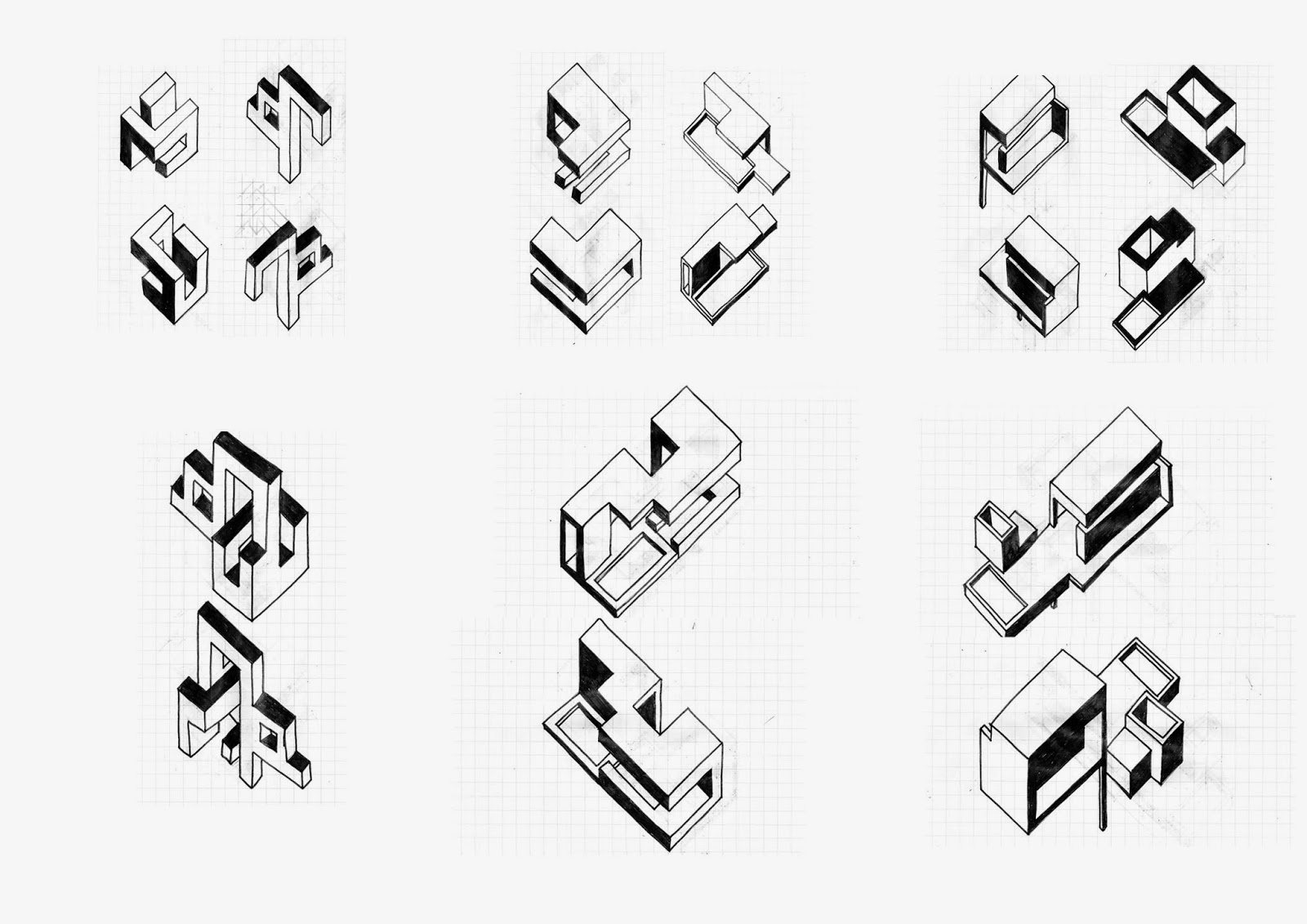
Pairs of Axonometrics and Interconnecting Pairs [Reworked]

Final pair of axonometrics developed in Sketchup

The top row of drawings involve the initial pair of axonometrics which reflect different quotes from Coop Himmelb(l)au and Antoni Gaudi. From left to right:

1. Basic shapes tilted and slanted within the landscape so that it appears to defy the laws of physics. - Coop Himmelb(l)au
2. Gaudi's emotional treatment of material and structure give expression to natural forms in architecture. - Antoni Gaudi
3. "Architecture of clouds" - Coop Himmelb(l)au
4. A transcendental form which arouses faith, belief and hope. - Antoni Gaudi
5. Imagination confined within the rules. - Antoni Gaudi
6. Structures are not fixed realities but shells for intervention. - Coop Himmelb(l)au

The bottom row of drawings involve interconnecting the two axonometric pairs above together. I decided to rework my axonometric drawings to refine the  use rectangular prisms to five. I have decided to develop three and four.

Monday, April 7, 2014

Sketchup Model in Lumion


Developed from combining axonometrics 3 and 8.

Pairs of Axonometrics

1. LEFT: Structures are not fixed realities but shells for intervention. - Coop Himmelb(l)au
2. RIGHT: "Spatial uncertainty, concept of structures with limitless space; its feeling of sequence, fragmented with holes and partitions, which create a divide without disrupting the feeling of openspace by enclosing it with barriers." - Antoni Gaudi

3. LEFT: Gaudi's emotional treatment of material and structure give expression to natural forms in architecture. - Antoni Gaudi
4. RIGHT: "Plenum (a space completely filled with matter). Places of Power." - Coop Himmelb(l)au
5. LEFT: An artist must obey creation. Reconcile architecture and nature. Write a story about the land. - Antoni Gaudi
6. RIGHT: A transcendental form which arouses faith, belief and hope. - Antoni Gaudi

7. LEFT: Surreal curvature of construction exceeding the boundaries of expectation. - Coop Himmelb(l)au
8. RIGHT: Embrace of imbalance, distortion, fragmentation and chaos. - Coop Himmelb(l)au